Fast-dry solvent, for the surfaces water-based ink cannot hold
This is the cartridge we quote most often, because it answers the commonest problem in industrial coding: the ink will not stay on the surface the customer actually prints on. A water-based ink wets carton perfectly and beads up on HDPE. Fast-dry solvent is formulated to wet low-energy surfaces instead of sitting on top of them.
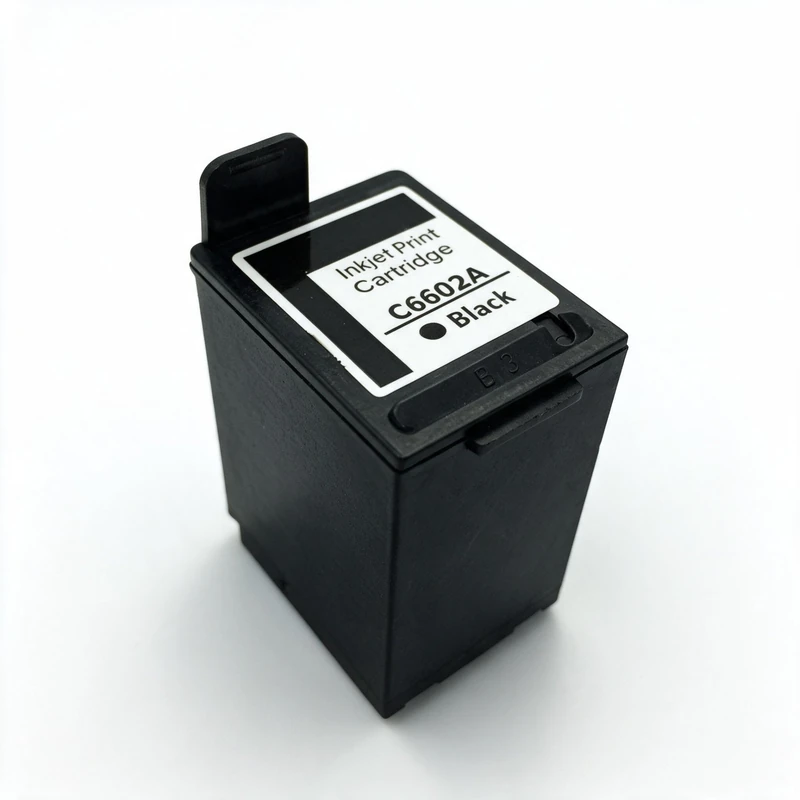
What arrives in the box
An HP45-format thermal inkjet body with a 42 ml industrial fill. Thermal inkjet means the reservoir, filter and printhead are one sealed assembly: there is no separate head to clean or align, and a failed nozzle is fixed by changing the cartridge rather than by a cleaning routine.
- 42 ml industrial fill, 12.7 mm or 25.4 mm print width
- Open, non-encrypted chip — second-source friendly
- Six colours, including white for dark substrates
Why a solvent carrier, and when it is the wrong answer
A liquid wets a solid only when the solid's surface energy comfortably exceeds the liquid's surface tension — the working margin is roughly 8 to 10 mN/m. Carton and paper absorb, so the barrier never appears. Polyolefins raise it: untreated PP sits around 26–28 mN/m and HDPE around 28–32 mN/m, both below what a water-based coding ink wets with any reliability.
A solvent carrier narrows the gap by lowering the liquid side — the fast-dry class sits near 23 mN/m static, against roughly 30–45 mN/m for a water-based ink. That is why the same polypropylene closure that sheds a water-based code will hold a solvent one. Where the gap is still too wide, the answer is pretreatment rather than another cartridge: corona or flame treatment lifts HDPE to roughly 38–42 mN/m and PP to 40–44 mN/m.
It is the wrong answer on plain uncoated carton, where a water-based ink already works and costs less. It is also the wrong answer where the print position cannot stay close and steady, because TIJ droplets only travel a short way.
What the data sheet actually says
Platform values are properties of the TIJ 2.5 body, not measurements taken on your material. Drying and adhesion are settled by a sample on your line.
| Parameter | Value |
|---|---|
| Platform | HP45-format thermal inkjet (TIJ 2.5), one-piece cartridge |
| Ink system | Fast-dry solvent carrier, formulated in house |
| Nominal capacity | 42 ml industrial fill |
| Print width | 12.7 mm (half-inch) and 25.4 mm (one-inch) |
| Resolution | Native 300 dpi, up to 600 dpi depending on print mode |
| Nozzle array | 300 nozzles per row, 1/300 in pitch, offset rows (platform characteristic) |
| Drop volume | Approximately 29–38 pl, model and print-mode dependent |
| Fire frequency | Typically 12–18 kHz, model dependent |
| Optimal throw distance | 1–2 mm optimum; workable to about 5 mm, though placement gets looser as the gap opens |
| Drying | Typically 1–5 s on non-porous surfaces — confirm against your line speed |
| Decap | Head idles roughly 10–15 min on fast-dry solvent before the plate begins to dry; confirm per ink |
| Chip | Open, non-encrypted — no authentication handshake, no single-use lock-out |
| Colours | Black, cyan, magenta, yellow, white and red |
| Operating environment | 15–35 °C, 35–80% relative humidity, non-condensing |
Six things that decide whether it fits your line
Formulated for low-energy surfaces
The solvent carrier wets HDPE, PP, PET, rigid PVC and coated metal that a water-based ink will not hold. Adhesion still depends on surface energy, so pretreatment is often required — untreated PP sits around 26–28 mN/m and HDPE around 28–32 mN/m.
42 ml industrial fill
The full industrial fill in the HP45-format body, not a reduced service fill. Actual cartridge life follows character height and content density, not volume alone.
Open chip, no lock-out
No authentication handshake and no single-use enforcement, so the cartridge can be qualified as a second source beside your existing supply without replacing printers.
Two print widths from one platform
12.7 mm for single-line date, batch and serial codes; 25.4 mm for multi-line content, logos and 2D codes in a single pass.
Whole-cartridge replacement
Nozzle plate, reservoir and filter are one sealed assembly. A dropped nozzle is resolved by changing the cartridge — no cleaning station, no service visit.
Low minimum, fast custom work
Standard black TIJ ink runs from 50 cartridges; specialty colours such as white or yellow pigment from 200–300. A custom formulation reaches production in 4–6 weeks with our in-house team.
Typical applications
- Date, batch and lot coding on HDPE and PP containers and closures
- Serial and traceability codes on PET bottles and PET film
- Coding on coated aluminium foil, metallised film and lacquered tinplate
- Cable, tube and profile marking where the code has to survive handling
- Secondary packaging carrying a lacquer or varnish
- Dark parts where a white or yellow pigment grade supplies the contrast
Four checks that save a trial
- 1. Confirm the print width against your printer carriage before ordering. A one-inch (25.4 mm) body needs a carriage and seat that accept it; many compact handheld units take the half-inch body only.
- 2. Where the substrate is PP or HDPE, ask your converter for the current dyne level, or measure it. Corona treatment decays in storage, so a roll that has sat in a warehouse can behave differently from a freshly treated sample.
- 3. Cure is not the same as dry-to-touch. A code wiped or abraded immediately after printing can come away while it still looks set — allow for cure time in the line layout.
- 4. A solvent cartridge belongs in a printer specified for solvent, with a capping arrangement that tolerates it. Do not fit one to a deskjet-class machine to see what happens.
12.7 mm or 25.4 mm, and what the chip does
Print width is a ceiling rather than a preference. A 12.7 mm half-inch body carries one line of date, batch or serial comfortably, and two compact lines at reduced character height. Move to a QR or Data Matrix sharing the band with a date line and the half-inch forces the symbol small enough that end-of-line scanners begin refusing it — that is where 25.4 mm stops being an upsell and becomes the difference between a code that scans and one that does not.
The wider body also has to be carried: many compact handhelds accept half-inch only, so confirm the seat before comparing anything. Print width is moulded into the cartridge; no setting changes it.
The chip is a separate decision from the ink. Ours is open and non-encrypted: the printer need not complete an authentication handshake, nothing blocks it after a single use, and no firmware gate rejects it for failing to be an original part. That is what makes second-source qualification practical. It is not a promise that every printer, firmware release and carriage behaves identically — qualify it the same way you would anything else, with one cartridge on your machine.
Minimums, lead time and samples
Standard black TIJ ink runs from 50 cartridges. Specialty colours — white or yellow pigment formulations among them — start at 200–300, because they carry a heavier solids load and a different handling routine. Price is quoted per order rather than published as a list, since the figure depends on the ink system, the colour and the quantity.
A custom formulation reaches production within 4–6 weeks, handled by our in-house team of 12 chemists and engineers. Every cartridge is pressure-tested and print-tested before it ships.
The fastest way to settle whether this cartridge suits your line is a printed sample on your own material. Send the substrate, the line speed, the code content and the distance from the head to the first point of contact.
Get Started
READY TO SCALE
YOUR PRINT OPERATION?
Send us your printer model and monthly volume. We'll respond within 24 hours with pricing, spec sheets, and sample availability.